
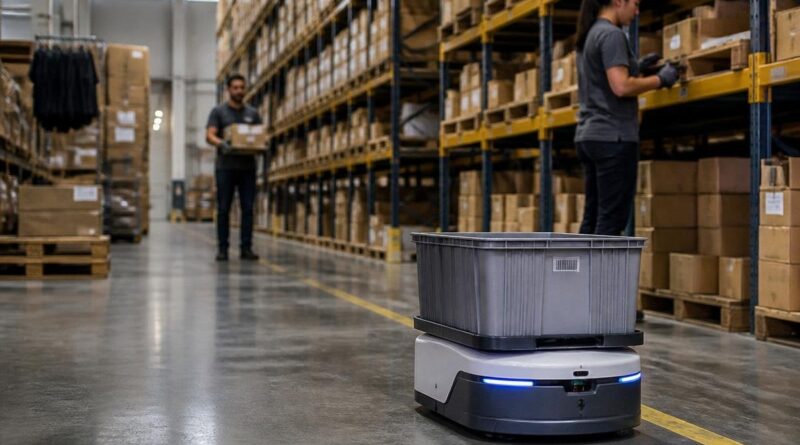
Warehouse robots can ease labor shortages, but they can’t end them
One warehouse robot can move goods, scan locations, or bring a shelf to a worker. That can reduce the number of people needed for some tasks, but it doesn’t remove the need for people across a warehouse.
- Robots work best on repeatable movements and fixed routes.
- People still handle exceptions, repairs, safety checks, and changing orders.
- The useful question is which tasks a robot can take over at an acceptable cost.
The work robots can take over
Warehouse automation works when the task follows a clear pattern. A mobile robot can carry a tote between two points.
A robotic arm can pick items when their size, shape, and position stay within a known range. Software can send work to the next available robot and track each move.
Those tasks take time from warehouse staff. Giving them to robots can let people focus on work that needs judgment, such as checking damaged goods or fixing an order with the wrong item. The result is a change in the job mix, not an empty building.
The limit starts with variety. A robot built for flat cartons may struggle with a soft bag, a tangled cable, or an item hidden under another item. A person can adjust their grip after seeing the problem. A robot needs sensors, software, and a safe way to stop before it can do the same job.
Why a shortage does not disappear
A labor shortage means a warehouse has fewer available workers than it needs for its planned work. Robots can reduce that need in selected areas, yet the warehouse still needs people to load equipment, maintain machines, manage inventory, and respond when the plan breaks.
The new work can call for different skills. A site may need technicians who can inspect motors, replace worn parts, check sensors, and restart a robot after a fault. Supervisors also need to understand how software assigns tasks and where a delay began.
Training takes time. So does changing a building for automation. The site may need new charging points, marked travel lanes, guarded robot areas, network coverage, and rules for people working near moving equipment. Those changes can make a robot useful, but they also add work before the first shift runs.
The cost test matters more than the demo
A robot earns its place when it can handle enough work, for enough hours, with enough uptime to cover its purchase and running costs. A short demonstration can show that a machine completes one task. It can’t show how the machine deals with blocked routes, empty shelves, software errors, battery charging, or a damaged package.
For a warehouse manager, the useful record includes the task rate, the number of stops caused by faults, the time needed for service, and the work still done by people. The calculation also needs installation, training, safety equipment, software fees, and spare parts.
Those numbers matter more when a report names the warehouse, robot, task rate, and work still done by people. Robot 24 can give you that record before you decide if a labor gap calls for a robot or a different staffing plan.
The strongest case for robots often comes from dull, repeatable work that is hard to staff for long periods. The weaker case involves mixed items, changing layouts, and tasks where every object arrives in a different position.
What remains unproven
Robots can reduce pressure on hiring, but their effect depends on the whole operation. If a machine handles picking while packing stays slow, the delay moves to another part of the building. If the robot needs a person beside it for most exceptions, the labor saving may be smaller than the sales material suggests.
The wider question is how many workers a warehouse can retrain for technical and supervisory jobs. That depends on local training, pay, shift design, and the time available for learning. A machine cannot fix those conditions by itself.
I wouldn’t count on robots ending warehouse labor shortages. I would count on well-chosen systems reducing the number of people needed for narrow, repeatable tasks.
A practical check before buying
Use this short check before you approve an automation project:
- Name the task: record the movement, item type, route, and exception cases.
- Measure the baseline: count the labor hours, delays, errors, and stoppages today.
- Watch the full cycle: include charging, recovery after faults, maintenance, and handoffs.
- Set a people plan: decide who will supervise, repair, load, and check the system.
- Test the ugly cases: use soft packages, blocked routes, empty locations, and mixed orders.
Sites that pass those checks may cut hiring pressure in one area. They still need a plan for the people and tasks around the robot. The next useful proof is a full shift of operation with faults and exceptions counted, not a polished clip of one successful run.